


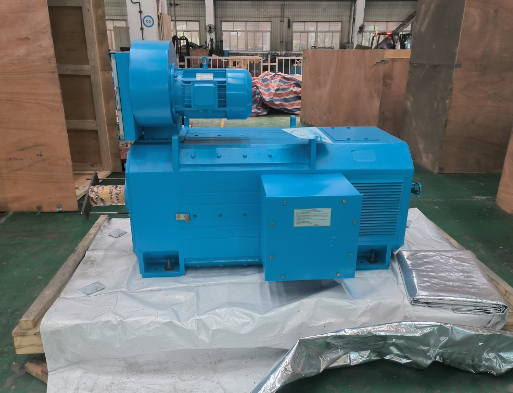


Why does a motor exhibit a "shuddering" phenomenon at the instant of startup or power disconnection?

During motor testing, if variable voltage or variable frequency starting methods are employed, the motor's startup process tends to be relatively smooth and balanced. Conversely, when the motor is started using its normal operating voltage, a relatively distinct shuddering phenomenon is often observed. Similarly, if a motor operating under normal conditions is suddenly cut off from power, a similar phenomenon occurs—sometimes accompanied by noticeable noise.
- Mechanical Resonance Effects:
When the excitation frequency acting upon a motor's mechanical system during operation approaches one of the system's natural frequencies, a significant resonance phenomenon occurs. This manifests as pronounced displacement resonance and, at times, generates audible noise resulting from the vibration. The "shuddering" observed during the motor's startup or power-down sequences is, in essence, a specific manifestation of such resonance.
This type of issue also frequently arises during the operation of variable-frequency motors. While a variable-frequency motor may perform exceptionally well within certain frequency bands, it may exhibit distinct electromagnetic noise in others; the fundamental cause of this discrepancy lies in the effects of electromagnetic resonance.
- Manifestations of Changes in Inertial State:
Both the startup and shutdown processes of a motor fundamentally involve a change in inertial state. This process of altering inertia—specifically, the process wherein the forces acting upon the moving object undergo change—is characterized by a direct correlation: the shorter the duration of the change and the greater the magnitude of the applied force, the more pronounced the resulting change in state becomes. The direct physical manifestation of this phenomenon is vibration—a sensation that can be intuitively perceived by humans; in the context of motor products, this typically presents as variations in sound and physical displacement.
Consequently, secure mounting and fastening are essential during the installation and operation of a motor. This typically involves securing the motor via its foot mounts or end-cover flanges to a designated mounting base, and, where necessary, implementing additional mechanical stops or limiting measures. Furthermore, during the course of normal operation, unavoidable vibrations may eventually lead to the loosening of these fasteners; therefore, regular inspection, maintenance, and servicing are of paramount importance.