


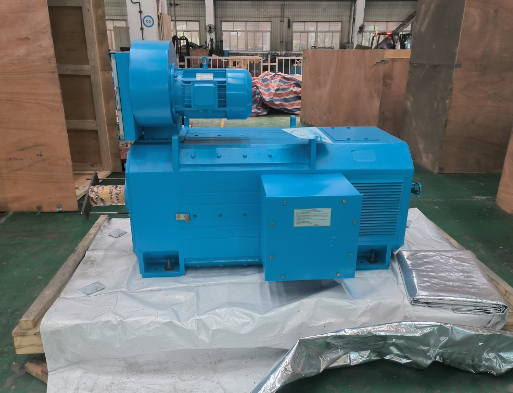


Cold-Climate Motor Sourcing: Daily Cold Over Extreme Limits
Cold-Climate Motor Sourcing: Daily Cold Over Extreme Limits
As industrial projects rapidly expand into high-latitude and ultra-cold regions, selecting the right heavy machinery for deep-freeze environments remains a critical challenge for procurement teams worldwide. To address this issue, our engineering and technical division has released a critical guide on industrial three-phase induction motor selection under severe winter conditions.
The core takeaway is vital for project budget control: motor R&D and sourcing parameters must center fundamentally on the regular operating ambient temperature, rather than brief, occasional extreme limits. This approach aligns with standardized industrial thermal design frameworks, successfully maintaining total system reliability while eliminating unnecessary over-engineering and procurement premiums.
The Sourcing Reality: Steady Operation vs. Occasional Drops
In international cold-climate industrial complexes, field settings present two distinct temperature benchmarks: a long-term, stable baseline temperature and a short-lived critical minimum.
For instance, in a typical cold-weather facility, three-phase electric Induction Motors run continuously at an ambient baseline of-45°C for the vast majority of the calendar year. Conversely, a drop to an extreme limit of -50°C represents an occasional, brief environmental condition with a short duration. Faced with these conditions, professional motor manufacturers establish the continuous -45°C baseline as the absolute parameter for standard winding architecture, structural steel/cast selection, and full thermal load calculations.
The Pitfall of Over-Engineering the "Survival Boundary"
Technical specialists explain that extreme temperature limits signify the absolute survival boundary that essential motor components—such as stator insulation matrices, internal bearings, low-temperature lubricants, and frame seals—can survive before experiencing physical breakdown. It serves exclusively as a defensive design threshold for brief spikes, not a recommended long-term operational envelope.
If a procurement specification mistakenly demands full structural upgrades tailored exclusively to continuous operation at the -50°C extreme, the manufacturer must implement exotic ultra-low-temperature steel alloys and custom processes. This generates massive structural redundancy and inflates unit prices.
In contrast, a standard three-phase induction motor optimized for a regular -45°C atmosphere naturally features built-in thermal resistance to survive sudden, brief exposure down to -50°C.
Component Lifespan & The Thermodynamic Benefit
Severe sub-zero weather heavily stresses mechanical parts: lubricant viscosity skyrockets, standard cast iron components become highly brittle, and terminal box seals risk cracking.
However, when a three-phase induction motor runs in its designated continuous environment, internal winding and rotor core losses naturally generate structural heat (known as temperature rise). This thermal micro-climate keeps the grease fluid and materials ductile, protecting the components from catastrophic failure. Operating a motor within its designed regular temperature zone ensures that all components function at peak efficiency, preventing common cold-weather failures and significantly reducing unexpected production downtime.
Streamlining Your Request for Quote (RFQ)
To skip common purchasing mistakes and balance operational integrity with budgetary restrictions, international buyers, engineering integrators, and industrial site operators are advised to provide three key parameters during the technical inquiry stage:
-
Regular Operating Temperature: Determines continuous duty baseline calculations, standard winding slot fill, and long-term cooling efficiency (e.g., -45°C).
-
Short-Term Extreme Limit Temperature: Used for verifying material survival boundaries, low-temperature cold start limits, and structural alloy validation (e.g., -50°C).
-
Expected Duration Profiles: Allows application engineers to compute exact thermal margins, eliminating unnecessary material redundancies.
By clearly establishing these individual temperature profiles and following the rule of "designing for the norm, verifying for the extreme," cold-climate industrial operations can guarantee seamless, safe machinery uptime while precisely maintaining sourcing budgets.