


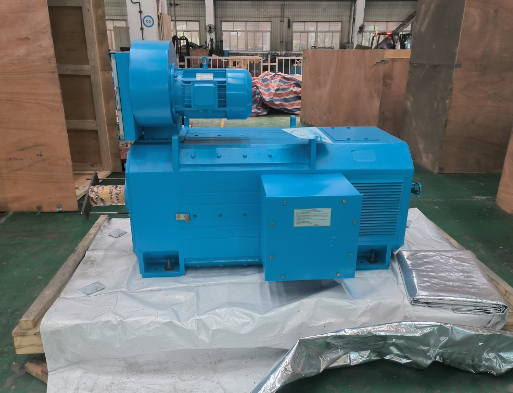


Advantages of Direct Neutral Grounding Scheme for Large-Capacity High-Voltage Motors
Industry Background
With the increasing demand for high-reliability motor drive systems in continuous industrial processes such as petrochemical plants, power generation units, metallurgical production lines, and large-scale water treatment facilities, the selection of neutral grounding method for large-capacity high-voltage motors has become a critical engineering design consideration.
For motors typically rated above 1000 kW, grounding strategy directly impacts system safety, protection performance, and long-term insulation reliability.
Among different grounding methods, direct neutral grounding (solid grounding) is increasingly adopted as a robust and practical solution for modern high-power motor systems.
1. Reliable Zero-Sequence Fault Current Path
Direct neutral grounding provides a solid low-impedance path for zero-sequence current circulation.
In the event of a single-phase-to-ground fault occurring in motor windings, feeder cables, or terminal boxes, a stable and clearly identifiable fault current is established. This ensures reliable operation of protection devices such as:
- 50N/51N earth fault overcurrent protection
- Restricted Earth Fault (REF) protection
As a result, fault detection becomes more sensitive, stable, and predictable.
2. Fast and Selective Fault Isolation
Compared with resistance-grounded and ungrounded systems, direct grounding generates a significantly higher earth fault current level, which greatly improves protection discrimination capability.
This enables:
- Rapid tripping of the faulty motor or feeder
- Accurate fault localization
- Prevention of fault escalation into phase-to-phase short circuit or severe winding damage
Therefore, system downtime and equipment damage risk are significantly reduced.
3. Improved Protection Coordination in Complex Power Networks
Large-capacity motor systems are typically integrated into multi-layer electrical networks including transformers, switchgear, long-distance cables, and distributed protection relays.
Direct neutral grounding provides a stable and unified zero-sequence reference, which enhances overall protection coordination by:
- Reducing relay miscoordination risk
- Avoiding nuisance tripping caused by unclear grounding paths
- Improving selectivity across upstream and downstream protection devices
Compared with resistance grounding systems, solid grounding offers more deterministic fault behavior, which is critical for coordinated protection design.
4. Effective Suppression of Transient Overvoltage
In ungrounded or high-resistance grounded systems, capacitive coupling effects during ground faults or switching operations may lead to transient overvoltage conditions.
Direct neutral grounding effectively stabilizes system neutral potential and limits voltage rise, thereby:
- Reducing electrical stress on stator winding insulation
- Minimizing partial discharge risk
- Extending insulation system lifetime
This is particularly important for high-duty-cycle motor applications with frequent start-stop or load variations.
5. Enhanced Operational Simplicity and Maintenance Efficiency
From an operational perspective, direct neutral grounding offers a simpler and more transparent system configuration, with advantages including:
- Easier fault analysis and diagnosis
- Reduced dependence on complex insulation monitoring systems
- Lower long-term maintenance complexity
It is highly compatible with modern digital protection relays and widely used in standardized industrial power distribution systems.
Conclusion
Direct neutral grounding has become a mature and widely adopted grounding scheme for large-capacity high-voltage motor systems.
Its advantages in fault current visibility, protection speed, system coordination, and insulation stress control make it particularly suitable for critical industrial applications requiring continuous and highly reliable operation.
Compared with resistance-grounded and ungrounded systems, solid grounding provides more deterministic fault behavior and stronger protection performance, which aligns well with modern industrial expectations for safety and operational stability.
As industrial power systems continue to evolve toward higher capacity and higher reliability requirements, direct neutral grounding remains a key engineering solution for high-power motor applications.